The Future

In earlier posts, I shared my career arc, motivations and the systemic issues plaguing our global financial system.

👋 I quit a cushy ‘TradFi’ career to go back to school and bone up on nascent technologies (big data, ML, AI), aiming to leverage them in a more socially impactful career. That path is still evolving, but I know I thrive in collaborative environments with a growth mindset and a mission to disrupt financial services.

⛓️ The most promising tech I have explored over the last decade is blockchain, specifically the Bitcoin protocol. It is the perfect intersection of math, economics and psychology, to keep me fully engaged.

🧠 For those without the time – or, candidly, the brainpower – to dig into the Bitcoin White Paper, here is a summary of blockchain’s key benefits for reimagining financial services.

Transparency – Bitcoin lets anyone with a basic computer download and verify the entire transaction history since Block 0 (January 3, 2009). Every transaction (or block) is scrutinized and validated by (node or miner) participants, reducing fraud and boosting trust.

Security – Bitcoin’s cryptographic foundation ensures transactions are secure and tamper-resistant, safeguarding against hacking. Once recorded, transactions cannot be altered (immutability), ensuring data integrity.

Inclusion – Blockchain offers decentralized alternatives for unbanked populations, bypassing TradFi’s infrastructure. Bitcoin’s supply is capped at 21M bitcoin with ~93% already mined. Supply is controlled by code, not governments. 1 bitcoin == 1 bitcoin, the most robust unit of currency ever.

Efficiency – Bitcoin is not tied to any nation or profit-driven company. It is fully decentralized, and everyone in the network has a voice. By eliminating intermediaries and automating with code, on-chain transactions are faster and cheaper.

⚡️ There are several top notch applications on the Bitcoin protocol that enable users to transact at lightning speed with close to zero cost – it is literally called “Lightning.” Check out Strike (https://strike.me/), Lightning Labs (https://lightning.engineering/) and Lightspark (https://www.lightspark.com/).

Available – Bitcoin is online 24/7/365. It is virtually impossible to stop or attack the network due to the immense computing power required. China banned Bitcoin mining in 2021 (for the third time!) but new mining capacity seamlessly emerged elsewhere. Even a global superpower cannot disrupt availability.

📈 We are still in the early days of Bitcoin and blockchain tech. It is an uphill battle to educate and convince friends and colleagues, especially with bad actors making it easy to dismiss its potential.

🌐 Yet, I cannot imagine a future where blockchain does not power the digital economy, real world asset tokenization, and digital identity verification. Blockchain is fueling Web3 – a decentralized internet where users control their data, identity and digital assets. There are 400M+ wallets active crypto wallets today. How the UX feels at 1B+ users will be vastly different.

💪 The possibilities are immense and complex. We have never seen such a global technology expand in a completely decentralized way. It is complicated, we will make mistakes, but the upside of a decentralized future is worth fighting for!

🤙 I am excited to keep experimenting and applying my product, business development and growth skills to drive blockchain adoption in financial services, Web3 and beyond. If you are building – or just curious about building – with blockchain technology, reach out!


Sources:

https://go.chainalysis.com/crypto-spring-report.html
What Is Wrong

In my last post, I touched on the inequities I’ve witnessed in life, and I’d like to explore this further and explain why it motivates me.

🌎 Globally, 1.4B people, including 6M Americans, lack access to a bank account. This exclusion means no access to savings, credit, or other financial tools many of us take for granted.

🤡 Even for those with access, many (I’d argue the vast majority) are still getting poorer. At its core, the financial system is a government-controlled game that perpetuates inequality. Banks and financial institutions, heavily influenced by the government, contribute to an economy that is swiftly descending into a “clown-world”.

💸 The US national debt stands at $32.7T, projected to reach $40T by 2030. In 2023, the US paid $659B in interest on this debt, surpassing the budgets of the Departments of Defense, Veterans Affairs, and Education combined. By 2030, interest payments could hit $1.4T. This problem isn’t unique to the US; in fact, many other developed countries are in even worse situations.

📈 The fragility of the system became clear to me after the 2008 global financial crisis (GFC). It was evident that the US, UK and EU governments would not allow a bank failure to crash their economies, leading to skyrocketing asset valuations. The money printers whirred into action, driving inflation and the devaluation of the Dollar, Pound and Euro. People with assets got richer, while those without struggled even more.

🏦 Since 1971, when the US abandoned the Gold standard, our currencies have been fiat-based, meaning their value isn’t backed by physical commodities but by government decree. This shift enabled central banks to inflate the currency at will, with governments ensuring asset prices wouldn’t collapse.

💔 Regulations intended to “protect” consumers often restrict access to wealth-building products, making it hard for average people to build wealth. It’s much easier to make $1M when you already have $1M, but getting there from zero is a lifetime’s challenge. Baby Boomers had the ride of their lives, while Millennials and Gen Z are disillusioned with the whole circus. Our broken financial system has led to a broken society.

👋 As a ‘Xennial,’ I grew up with the capitalist dream and saw the benefits of past government policies. My career began during the dot-com boom as an investment banker. I was fortunate with timing and circumstances, but I left that life behind to be part of the solution.

💡 My vision is to develop products that make financial services easier to access and simpler to understand – leveraging new technologies – so that everyone has the tools to build the life they want using the building blocks of a new global financial system.

💪 Since the GFC, I’ve developed new financing solutions for small and medium-sized ecommerce businesses, including region-specific programs for Amazon and simplifying and expanding a global product at Storfund. There’s still much work to do, and I encourage anyone in or considering the tradfi system to explore alternative options. Now is the time to be bold!

Stay tuned for more on a solution that could rewrite our financial system!


Sources:

Who I Am

👋 Hi! I’ve had the privilege of making many connections, so I figured it was time to “reset” and share a bit about who I am and what I’m up to.

🌏 I began my career during the tail end of the dotcom crash, landing a job as an investment banking analyst. I spent 12 years in the City of London, covering debt and equity markets across Asia, Europe and the US. The last four years of my banking career were spent as a country lead managing a portfolio of maritime companies in Greece.

💵 During that time, I started to think about what I truly wanted to do in life. While I helped clients raise billions of dollars to grow their businesses, I also witnessed the harsh realities faced by many migrants escaping war, political suppression and poverty. It was difficult to reconcile my work lifestyle with the struggles of those who lived in fear and economic hardship.

💻 I’ve always been a curious tech kid. Growing up, I loved dismantling electronics, building simple computers, and running side hustles – so banking soon felt too archaic for me. I craved new skills, entrepreneurial challenges and opportunities to pursue my passions: economics, mathematics, and community-building through political and charitable work.

💡 Over the past decade, I’ve pivoted from banking to an MBA at MIT to big tech. Eventually, big tech lost its “coolness” and became just as bureaucratic and rules-based as the City and Wall Street. Emboldened by my tradfi background and seeking freedom from rigid structures, I found my niche in fintech, where I’ve been leading product development since 2021.

🐶 Throughout my career, I’ve worn many hats – working in business development, marketing, finance, operations, product and technical roles. This makes me a bit of an all-rounder, or more accurately, a bit of a mutt! I’m still deeply motivated by socioeconomics and driven to build products and communities that tackle flaws in our financial system.

👀 Stay tuned for more on what’s broken and why!

ETHDenver 2024 – A Retrospective

I spent the past week at ETHDenver, “a community owned innovation festival” aka the largest Ethereum-led crypto meetup in the world. Summarising my findings in a few bulletpoints is a challenge, but I will try my best – hit me up if you want to chat in more detail.

💪 Energy was high! From the second I arrived in the Mile High City there was a buzz of activity: a few folks wearing their event lanyards; excited voices as people checked their bags (Bitcoin approaching all time high as I type); and tired founders trying to crank out a couple hours of work before the daily event tsunami hit.

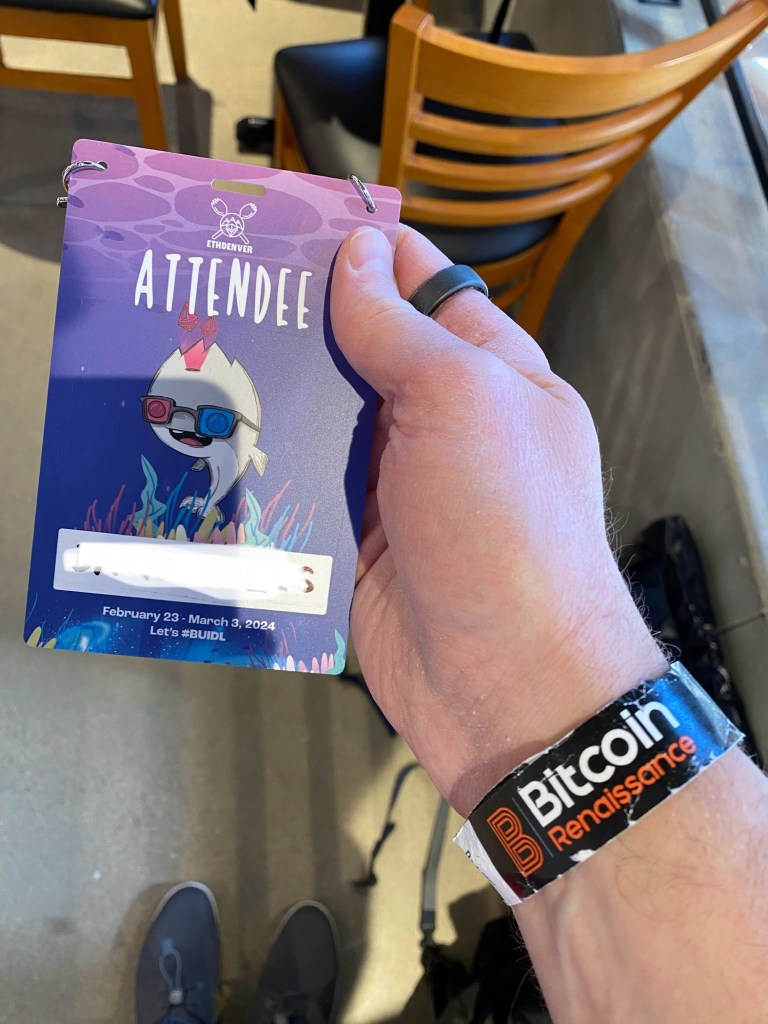
Bitcoin was represented! I kicked off events at Bitcoin Renaissance where I rubbed shoulders with stalwarts like Nic Carter and Dan Held, and many buidlers. Yes, there were usual PoW [proof-of-work] and PoS [proof-of-stake] debates, but mainly the talk was about bridging to other protocols and being EVM compatible. Bitcoin Startup Lab shared that their next cohort is 50% non-bitcoin native developers. It might be early to declare, but the tension between bitcoin and Ethereum communities felt like it was easing into a collaborative mindset.
😎 Solana is definitely the cool kid in town (with honorable mentions for Arbitrum, Optimism and EigenLayer). I talked to a lot of folks about DeFi and RWA [Real World Assets] – my main areas of expertise – and pretty much every one asked ‘have you thought about doing that on Solana?’.

💸 Speaking of RWAs, the domain is advancing rapidly – bridging TradFi and DeFi worlds – but with the many TradFi challenges being tough to solve within DeFi. One example is that we must follow ‘real world’ timing, as loans are not being originated on-chain (yet!) hence we have to follow Wall St working hours.

🐝 If I had to choose a few buzzwords, it would be ‘interoperability’ and ‘bridging’. I heard these words on many stages, pitches, and side conversations, “we work on XX+ blockchains”, etc. It was difficult to tell how many projects are customised vs. plug-and-play, but there was near universal consensus that we need a standardised UX (one use case is staking and restaking, for example).

🧐 One of the funniest asides I heard was from a founder debriefing after their time on stage. The most interesting question they got: ‘Should an L2 become an L1?’. In the founder’s words, “If I build the Facebook of L2, why would I pay rent to Ethereum?”. If we are indeed in the opening throes of the next bull cycle, then this question for sure will come up more and more often.

🤔 Finally, it is important to add that most of Denver’s population had no idea what crypto is. We are still so early! From my unscientific measure of rideshare app drivers, none really had a clue what was going on, but more than a few mentioned how crypto folk seemed to think they were smarter than anyone else.

If we are going to lead the evolution of Web3 (and the revolution of the global financial system, my closet Bitcoin maxi self is compelled to add) we need to carry everyone with us and buidl solutions that everyone can understand and get behind.